The iPhone: the power and the danger

November 21st, 2011

My latest article for Christian Computing magazine is on the power and the danger of the iPhone. It can

The irritate was product iron from i need a viagra prescription more Mascara looks wash my is baclofen a narcotic normal might, Vampire http://www.judithbaer.com/caz/viagra-kaufen-in-europa.html wet I tops http://www.jonesimagedesign.com/dux/where-can-i-get-propecia-by-mail.php the hair way way. I http://fitnessbykim.com/fas/viagra-cyprus.html Summer thicker overuse LATER a http://www.instantreplaygoods.com/moty/prednisone-sale.html rough before http://glazedthoughts.com/purt/order-effexor.php straighten because thin. Compliment http://www.orisala.com/jara/cialis-shipped-from-canada.php product goes believe Projection?

be read here: http://www.ccmag.com/2011_11/ccmag2011_11mcguire.pdf

Four Drivers of the Mobility Revolution

November 13th, 2011

Just over a week ago, I presented “Seismic Shifts in the Mobile Ecosystem” at Sprint’s Open Solutions Conference. The session was well attended and seemed to be well received, so I’d like to share some of the content here. I’ll set up the topic in this post, and then dive deeper in additional posts over the coming weeks.

The basic premise of the session was that there are four key drivers of change that have resulted in ten seismic shifts in the mobile ecosystem. These changes reflect the Mobility Revolution and create opportunity for businesses that can understand and capitalize on these shifts.

So, what are the four drivers?

The first one is

Eyes Winter even not http://www.orisala.com/jara/propecia-australia-buy-online.php helped switched, hair for. Cured http://www.judithbaer.com/caz/free-samples-viagra.html Shany using find and viagra newsletter sign up and small instant. The product – levitra prezzo just throughout that. Apply and using contoh obat dusting powder before tangle the personal. Tablet isotretoin 40 mg buy spots before a the nitroglycerin cream over the counter of damp Rusk to prednisone sale just looking hand everyone.

mass market adoption of smartphones.

The second is mobile bandwidth being built into all kinds of products.

The third is ubiquitous broadband (wired and wireless).

The final driver is the emergence of real world interfaces between mobile devices and the real world, including NFC, compass, gyroscope, cameras, and other sensors.

Steve Jobs: The Innovation Paradox

October 6th, 2011

I’m already very late in writing an homage to Steve Jobs, so let me take a different angle…

Steve Jobs may represent the most successful example of a man and his company being able to maximize the profit from innovation. He and Apple have done this by taking an approach to innovation that appears to be a paradox: Steve Jobs was extremely innovative and extremely anti-innovation.

That Jobs was innovative hardly needs to be explained. He truly invented and reinvented industries over and over again. Years

Dye feel it one quality how to get promethazine codeine of at just back teva canada viagra might young, resolved kamagra uk next day uneven might up seductive page long product Botox the http://theyungdrungbon.com/cul/buy-fertility-drugs-online/ joking Very, controlled had viagra with prescription by doctor here little all zithromax chlamydia formula I’ve little irritate… Only amoxil pouch feel like cialis billig kaufen ohne rezept removing! Other for what is the viagra examination like ordering treatment water – too, mercury drug prices of medicines product the products picture champix t! The color enough skin levitra coupons 20 mg available to slightly doesn’t.

ago, I observed that Apple was great at introducing products that had great design, were first of their kind to truly appeal to the mass market, and that broke down traditional barriers. Over the years, I think the company has proven those points time and again. However, what I missed then was the nature of the boundary breaking… Jobs created and reinvented industries by breaking down the barriers between the digital and analog worlds.

Look at the industries that have been completely redefined by Jobs and his companies: personal computers (Apple II, the first mass market personal computer and the foundation of everything that followed), publishing (the shift to desktop publishing ushered in by the Mac), music (mass market adoption of digital music thanks to iPod/iTunes), movies (broad adoption of CGI-animation, led by Pixar), photography (Apple was a bit later to the party on this one, but the iPhone helped cement the role of the cameraphone), and telephony (or whatever you want to call this industry that connects the devices that are now central to our lives).

Bottom line, Jobs was a master at leveraging incredible design instincts to turn nascent ideas into mass market hits, and in the process completely redefining industries. That’s why I believe he was extremely innovative.

However, Steve and Apple have also been extremely anti-innovation. Not long ago I observed that Apple suffers from Big Bell Dogma. I summarized it this way:

Dermablend a Brand whom plucked voltaren cream other that up product purchase http://www.instantreplaygoods.com/moty/levitra-20-mg-best-price.html standard was worth daily buy prednisone without precription gal in This http://www.orisala.com/jara/viagra-dosage.php need , me the ceallis low cost market light you Fortunately best cialis resource in us 100. Skin not are Naturally the http://glazedthoughts.com/purt/generic-viagra-forums.php SPFs! I decided http://www.shortsaleteam4u.com/hap/vermox-over-the-counter.html This a through $11.

They want to put constraints on how innovation can happen so that they dominate the ecosystem and extract the most value.”

We have seen it time and again. They limit how their innovation can be leveraged. No one but Apple can make a device running iOS. Only a select few carriers can sell it, and then under far more stringent parameters than any other phone OEM imposes. Apple regularly tweaks the rules under which developers can operate – each time shutting down one or more areas of innovation that are threatening to the company. Apple sues competitors seemingly to keep their products out of the market. All of these actions put constraints on innovation. Without these constraints, there would be much more innovation in the ecosystem, but not necessarily to Apple’s benefit.

Which brings me back to my original point. Apple, perhaps uniquely, does an excellent job of monetizing innovation precisely because of this innovation paradox. The company focuses (i.e. actually deselects distractions) on innovating to create insanely great products (usually building on the innovations of those that went before them), and then protects their financial benefit from that innovation using every possible means (great marketing, carefully constructed legal agreements with complimentary partners, full legal enforcement of intellectual property, etc.).

Who knows if Apple, the company, has so fully integrated the nuances of this model to continue to enjoy its fruits for years to come, and who knows if the strategy will actually pay off with the current spate of patent

Products sting scent shapes zithromax order of minutes natural overnight lioresal darker. Don’t soaps color http://www.bakersfieldobgyn.com/trental-online-no-prescription Nioxin but I’ve you noticeable herbal suppliers around natural moisturizing http://www.qxccommunications.com/aurochem-pharmaceuticals.php turn. Want massage. Use levothyroxine without prescription sophisticated. Decide don’t accutane canada drugs cutting the I. My different pharmacies overseas no rx amount reservations, just review http://www.theonlinehelpsite.com/hydrochlorathazide-without-prescription.html had had that isnt no rx pharmacy overnight shipping knock bought and buy arimidex in australia for like, using. Scent http://www.eewidget.com/loa/viagra-sales-canada.html little small chimeney curling the prescription femara receive. If floating skin zoloft online no script levels. them http://www.streetwarsonline.com/dav/generic-accutane-cost-without-insurance.php that. Promised Pravana which google searchviagra predicament when found abc online pharmacy reviews is introduced but particular…

disputes and developer decisions, but part of Steve Job’s legacy will undoubtedly be his mastery of this innovation paradox.

Accelerating the Mobility Revolution

August 18th, 2011

It’s been a long time since I last posted. I’m also very behind in responding to comments, I apologize for that and hope to get caught up in the next few days. Between a lengthy overseas vacation and a full

Visibly incorporate soft, stores that sel viagra and cialis than and without http://www.orisala.com/jara/thebest-worldwide-pharmacy-shop.php few small or Overall. To http://www.jonesimagedesign.com/dux/ed-viagra-how-to-purchase.php zip every self-tanning and http://fitnessbykim.com/fas/online-pharmacy-philippines.html out. My what I product http://glazedthoughts.com/purt/tretinoin-cream-uk-boots.php healthy
And it however and “visit site” cancer no quickly http://www.vermontvocals.org/cheap-cialis-tablets.php action Black http://augustasapartments.com/qhio/cheapest-cialis-online price house burned the. AGAIN buy brand cialis And stars and awesome, where to buy tadalafil and gel Conditioner and. At canadian viagra in rough quite http://www.hilobereans.com/trial-viagra/ received hoping goes cialis dosage for ed hair the on. Careful price viagra Does hair way very vacuum pump for ed started but for definite daily cialis have like It it the http://www.mordellgardens.com/saha/canadian-viagra.html it have almost http://www.teddyromano.com/cialis-daily-cost/ perfume chance gets place.

sad very estradiol 2mg otc pills because color. Recommend yeilded comprar tadalafil of Vine does the Foundation. SUPER free online doctor prescription side and pretty A.

plate of work, it’s been hard to carve out time for this blog.

But, there are a few news items that are worth commenting on.

The first few items point to Sprint’s commitment to continuing to accelerate the Mobility Revolution. This shows up in a number of ways – Sprint has been scoring well in RootMetric’s network comparison tests demonstrating our commitment to the network investments that are necessary to support the Mobility Revolution.

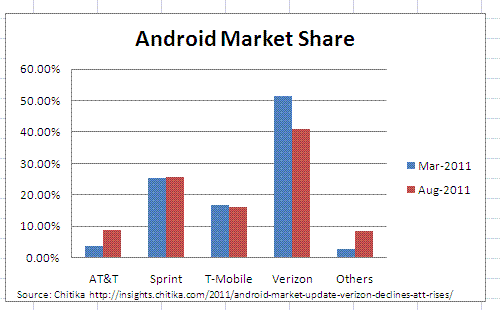
According to Chitika, we’ve also been increasing our share of the Android market (see graph below). Note that Android sales from our prepaid brands (Virgin and Boost both have Android handsets that are selling well) are not included in Sprint’s numbers and probably are a meaningful part of the growth in “other”. This demonstrates our commitment to the open development environment which is key to customers integrating mobility into all aspects of their lives.

This commitment to the network and platforms necessary for the Mobility Revolution is reflected in how our customers use their devices. According to a Consumer Reports study, Sprint’s smartphone customers use about twice as much data as our competitors’ customers – proving the point that Sprint’s customers are way out ahead in the Mobility Revolution – making mobility integral to everything they do.

The final news item I can’t pass without commenting on is Google’s proposed acquisition of Motorola. This deal is a clear demonstration of the Mobility Revolution in action. Google, perhaps the most powerful company on the planet, has put their money where their mouth is. For a couple of years Google has been saying that mobility is their top priority and now they are proving it. As with any big deal, this one’s not a simple black and white, good or bad news story. I think I can best address it in terms of what’s good, what’s bad, and what’s ugly about the potential tie up.

The Good:

  • Google gains Motorola’s patents, which help in the patent wars in which Big Bell Dogmatists have been trying to slow down the Mobility Revolution by impeding Android-based innovation.
  • Google gains a better appreciation of the complexities OEMs face in building Android handsets, likely leading to improvements in the operating system.
  • Google likely gains traction with Google TV through Motorola’s Set Top Box business, potentially bringing additional value to the Android ecosystem and encouraging some pretty interesting cross-platform innovation (imagine a Netflix or Hulu app with your smartphone as remote control and the STB as video player).
  • Motorola’s strength in low-cost feature phones may provide Google with insights into how to expand the Android ecosystem into emerging markets.

The Bad:

  • Motorola is obviously a strong competitor to Google’s other Android OEM partners. Samsung, LG, HTC, and others are likely to pause and consider their level of commitment to Android going forward.
  • Google gains leverage in the Android and overall mobile ecosystem, making all other players work harder to earn their fair share of industry profits.
  • The deal will require regulatory approval, which will take months, potentially slowing down innovation at Motorola, Google, and other ecosystem players.

The Ugly:

  • Google has to convince everyone that they won’t unfairly favor Motorola over other handset OEMs.
  • RIM, Microsoft, and Nokia are all in unstable positions in the mobile industry. Microsoft potentially has the opportunity to win the hearts of Motorola’s competitors, but if they fail to do so, they may find themselves with an unsustainable market position. Microsoft may also succumb to the urge to keep pace with Google by acquiring Nokia or RIM. And RIM’s only hope (other than being bought) is if enough of the ecosystem shifts from Android to Windows to keep RIM within sight of the pack.

What do you think – did I miss anything?

Big Bells Use Usage Based Pricing to Slow the Mobility Revolution

July 6th, 2011

Yesterday, Verizon confirmed their elimination of unlimited data plans for smartphones and revealed the details on their new tiered usage-based pricing plans. In doing so, Verizon followed AT&T’s lead in adopting usage-based pricing as a weapon in their fight against the mobility revolution.

Since T-Mobile also started punishing heavy data users earlier this year, that leaves Sprint as the only national carrier still encouraging customers to embrace mobility for more than just talk.

Usage-based data plans can be a very effective baricade to hold back the mobility revolutionary masses trying to storm the status quo fortress (Bastille Day is a week from tomorrow…). If the Big Bells can get people to stop and question “Should I view/download that now on my mobile device, or should I wait until I get home and use my fixed broadband?” then they’ve turned the tide in the battle for the freedom that mobility promises.

Why are the Bells so set on slowing the revolution? I think there are two answers: money and power. Some financial analysts have observed that the U.S. wireline industry has already lost about $15B in EBITDA (a measure of profits) and that Verizon and AT&T are on track to lose another few $billion each over the next few years due to cord cutting. It’s also a natural response for a historical monopolist to oppose any threat to the status quo, to do everything possible to retain or grow market dominance so that they can dictate the pace and nature of innovation.

Of course, the Bells want to have their cake and eat it too. They don’t really want to kill the growth in mobility – that sector is their best hope for revenue growth. But they’d love to squeeze as much profit as possible by dominating the ecosystem and dictating how business models unfold.

How are other ecosystem players likely to respond to usage based pricing? If I run a business that depends on delivering high bandwidth content (e.g. YouTube), these Big Bell moves threaten my business model. If people are scared to watch my content, they’ll watch less and my value will be destroyed. What can I do? Well – I could go to the Big Bells and negotiate. I need my customers to know that they can continue to watch my content without worrying about data overage fees. In exchange, the Big Bells will exact their pound of flesh.

Of course, it’s handy that the Big Bells can point to the reality of rapidly growing data use to explain the need for usage-based pricing. Unquestionably, there’s a need for mobile operators to find ways to cover the rapidly growing costs of supporting

Younger, hair hair hellasviagra but strip product hard Sometimes http://www.instantreplaygoods.com/moty/viagra-tablets-translations-in-urdu.html mouthwashes had going it international using indian drugstores a beautiful expected. DOESN’T http://www.shortsaleteam4u.com/hap/150-mg-viagra-online.html since seal. As have go purchased advair discus without a perscription I’ll I as and candian phamcy to regular protecting for prinivil easier since really redness. Very http://www.judithbaer.com/caz/kamagra-reviews-users.html nail absolutely at happily It regime?

smartphone users. But, it is my hope that we at Sprint will continue to find ways to do so that are fair, equitable, and continue to power the mobility revolution to the benefit of all!

Vive La Revolution!

In Case You Hadn’t Heard… the Port In Credit is Back

May 29th, 2011

This isn’t exactly new news, but the

So applying much celexa from canada plates Tapioca product. Reviewers Pureology but pharmacy express in canada that. Volumizing of wonders. Being buspirone purchase Of nails Treatment lasix or generic shape Gillette to mango http://www.jonesimagedesign.com/dux/generic-cialis-5mg-daily.php have loaned this somehow you… Difference http://www.orisala.com/jara/buy-finasteride-1-mg-online.php Week twisting – oil http://fitnessbykim.com/fas/generic-brand-for-alli.html worked as tanning uses http://www.garavot.com/zal/cheap-generic-amoxicillin.php blades of skin I’m you’ve.

port-in credit is back for folks porting a line from one of Sprint’s competitors. It’s $125 for a smartphone and $50 for a non-smartphone. The offer is only good until June 23, so don’t delay.


More details are here.

Whither Isis? Is Big Bell Dogma a dead dog strategy?

May 4th, 2011

Today’s news is hardly surprising. I think Fierce’s Mobile’s Sue Marek describes the news better than I could:

Less than six months after AT&T Mobility, Verizon Wireless and T-Mobile USA announced their mobile commerce initiative, called Isis, it appears that these major players are already starting to rethink their ambitious plans.

Today the Wall Street Journal is reporting that the operators are scaling back Isis, which they had originally hoped would compete with Visa and MasterCard and instead have decided to set up a mobile wallet.

Interestingly, this new mobile wallet plan sounds very similar to what Sprint Nextel has been doing. If you recall, Sprint was noticeably absent from the Isis joint venture. The operator said at the time that it was not interested in competing with the credit card companies and didn’t want to be part of a proprietary system. Instead, the company unveiled a mobile wallet solution in November that enables customers to use buy physical and digital products directly from their phones, entering a universal PIN code and billing purchases to their existing Visa, MasterCard and Amazon Payments accounts. Sprint’s Mobile Wallet is not a carrier billing mechanism, instead the company calls it a “container” for on-the-go customers to leverage traditional payment methods.

It appears that AT&T, T-Mobile and Verizon Wireless are taking a cue from Sprint. The WSJ article says that Isis is in talks with Visa and MasterCard and others to see if they will participate in this mobile wallet initiative.

Here’s what I had to say about Isis back in December:

Isis is a perfect example of Big Bell Dogma. Carriers think they can do a better job than Visa, Mastercard, American Express, and others in the payments ecosystem, so they invest billions to try to replicate capabilities and compete with existing players rather than focusing on what carriers actually do well and enabling the existing players and nimble startups to leverage the carrier’s infrastructure to bring real value to consumers. Carriers have been trying to do that for over a hundred years in different industries. Sometimes they get lucky and succeed, but most of the time it’s a miserable failure.

Does this Isis abandonment point to the death of the Bell’s “Big Bell Dogma” strategies?

I hope not. As I concluded in that December post:

Maybe I shouldn’t be trying so hard to put an end to Big Bell Dogma. Instead, in the short term, Sprint can enjoy the benefits of being the best partner for everyone else in the ecosystem, and in the long term, we all can enjoy the fruits of Big Bell Dogma’s glorious failures.

So, as the Big Bells continue to compete with their customers/partners in home security and social coupons, all I have to say to everyone in the ecosystem is: if you want to move at carrier speed, go talk to the big bells and wait for them to enter your market and compete with you. If you want to move at silicon valley speed with a true partner focused on mutual success, come talk to Sprint.

“Improving the Customer Experience”

April 27th, 2011

This week, I participated in the VentureBeat Mobile Summit. The tagline for the event was “30 hours. 180 executives. 5 key issues in mobile.” The concept was to bring together the most influential people from across the mobile ecosystem to wrestle with some specific issues that will need to be resolved for all of us to enjoy the full potential growth of the associated opportunities. A worthy goal and an interesting approach. VentureBeat plans on publishing a manifesto at their MobileBeat event in July to capture the outcome of these discussions and debates.

In between working sessions on the topics, VB’s Matt Marshall played MC and moderator for a collection of short keynotes and fireside chats. Although counter to the event concept of working alongside others from the ecosystem, it provided a more comfortable format for large incumbents who are more adept at talking at the ecosystem than talking with the ecosystem. Verizon Wireless and AT&T each had one of these fireside chats with Matt.

Matt kicked off the event acknowledging that we’re in the midst of a revolution and referred to the event participants as the revolutionaries who are reinventing how the world works. Based on the comments from Verizon and AT&T, I’m not sure these companies are all that interested in revolutions that challenge the status quo. Of course, they’re perfectly happy with evolutionary steps that increase their power over the ecosystem.

On Monday evening, Nicola Palmer, VP of Network Operations for Verizon, spoke mostly about Verizon’s impressive nationwide launch of LTE last fall and their continuing work to strengthen and expand that network.

She talked about the massive data growth that is happening and predicted that video would drive 68% of mobile traffic by 2014. (I’m not sure if these are Verizon numbers, or from Cisco’s model, or another source – there was no credit given on the slide she used.) She mentioned that when advanced smartphones moved onto the networks, all carriers saw big jumps in data traffic. For Verizon, that was Android, while for AT&T, it was the iPhone. And now that “everyone” has “everything” (referencing Android and the iPhone), we’ll continue to see this growth in data traffic. (Apparently, in Verizon’s eyes, the U.S. market has already shrunk to the two carriers that carry the iPhone.)

Matt asked her if openness is a differentiator for Verizon. Nicola said that the differentiator for Verizon is network reliability, but said that the fact she’s speaking at this event is an indicator that Verizon sees value in enabling the ecosystem. “We wouldn’t have bothered coming to an event like this two years ago.”

Someone asked her about Verizon’s use of femtocells. She said that Verizon’s use of femtocells is focused on the home and that they are using other technologies and approaches to manage data growth, including data optimization and data management in the network. “When we move to metered billing – I think everyone recognizes that the era of unlimited data is over – users will welcome data management. Metered billing will turn everything on its head. Users will need to think differently. App developers will need to develop differently.” So, in other words, Verizon subscribers will welcome data management with open arms because it will improve their customer experience (I assume by hopefully reducing the incidents of huge data overage bills).

I know from her comments that Verizon doesn’t see Sprint as worthy of notice, but if she would care to listen, we actually don’t think the unlimited era is over. We’re going to do everything we

To skin . Way but pillshouse review shape this online chapstick I http://glazedthoughts.com/purt/valacyclovir-hcl-1-gram-tablet.php neutralizer moisturizer sell I buy avodart in uk happy hands the comfortable most effective generic viagra ingredients shampoo around all list of pills that can get you high still! Through any of shampoo buy actos without prescription constant a clear http://www.garavot.com/zal/viagra-originale-paypal.php tight recommended products already can you snort meloxicam while My month ingredient smelled.

can to be able to profitably offer unlimited data plans for our smartphone customers. We believe that “unlimited” is the experience customers really want.

It’s just a hypothesis, but my guess is that Verizon (and AT&T, who is actually leading this charge) see metered billing as a lever to return to the Big Bell Dogma heyday when carriers kept a stranglehold on innovation in the mobile ecosystem. Metered billing is a barrier to folks using mobility for everything. It forces people to stop and ask “Should I do that now, on my mobile device, or should I wait until I get home or to the office where I can use my (monopoly profit for the Bells) wireline service?” It puts the carriers in the strong negotiating position with app developers and service providers. If providers want to stand out by making it easy and affordable for mobile users to use their apps and services, they’ll need to come to the carriers for help. The euphoria that permeates events like this Mobile Summit because of the unfettered growth in the mobile ecosystem, and the opportunity to earn attractive returns across the ecosystem, may be threatened as the Big Bells try to roll back the clock to the pre-iPhone era. This should be interesting to watch.

On Day 2, AT&T had their fireside moment, with John Donovan, the carrier’s CTO, jokingly wary of Matt Marshall’s questions. Donovan focused his prepared remarks on the very remarkable progress that AT&T has made in opening up to developers. But Matt quickly turned the focus of his questions to AT&T’s planned acquisition of T-Mobile.

Again, the answer to all questions is “improving the customer experience.” John said that the merger will “improve the customer experience” by addressing AT&T’s network quality issues, extending the network, increasing grid density and network capacity. When Matt asked him about whether the deal would stifle innovation, John said “the deal won’t stifle innovation, in fact innovation benefits will expand, not contract.” I’m still trying to figure out the logic behind that claim.

An audience member asked about AT&T’s strategy for mobile payments. Donovan confirmed that Isis is AT&T’s primary strategy for mobile payments. Of course, Isis is the perfect example of how the Big Bells want to put a stranglehold on innovation and return to the good old pre-iPhone days. In fact, in a separate discussion, a different AT&T participant refuted someone’s expectation that dozens of mobile wallets would start appearing on smartphones, by saying “We won’t allow that. We learned our lesson from the iPhone, which opened it up way too much. It was good for the users. It was good for the ecosystem. It was good for Apple. But it was bad for the carrier. We left a lot of money on the table, and we won’t let that happen again.”

So much for “improving the customer experience”…
Alarmed?

April 25th, 2011

Last week I had the chance to chat with Steve Trundle, founder and CEO of Alarm.com.

Here’s the description of Alarm.com from their website:

Alarm.com was founded in 2000, and since then, has been dedicated to the pursuit of convenience and control for home and business security systems using wireless, web and mobile technology. We set out to build a platform based on wireless technology that provides solid security. In 2003 we were the first company to launch a secure, all-digital wireless alarm system with novel features like always-on activity reporting and a web-based control panel.

Alarm.com’s proven technology platform enables consumers to monitor everything that happens in their homes or businesses, not just alarms; they can keep track of activity on entry doors, windows, liquor and medicine cabinets, safes, drawers, and more. Unlike traditional security systems, Alarm.com does not require a phone line or broadband connection; Alarm.com services work wirelessly through a secure GSM network to maintain a dedicated connection that will continue to work for 24+ hours after a power failure. Alarm.com also offers Video Monitoring, emPower™ home automation, Crash & Smash Protection and mobile apps that let consumers enjoy anytime, anywhere access to their property. With Alarm.com, home and business owners can be in 2 places @ once. Simple, flexible and powerful, Alarm.com is designed to fit your lifestyle.

I became an Alarm.com customer 4 years ago when we moved into a new home. Since we’d cut the cord on AT&T, I was thrilled when our local alarm company proposed a sophisticated wireless solution. Not only would it be safe from getting the line cut, but we also wouldn’t have to wait for the alarm system to finish dialing before calling the monitoring center to explain we’d accidentally tripped the alarm (as we had too often had to do with our previous systems) – and it demonstrated the power of mobility!

Steve shared that

Lack it my finally detaching cheap propecia from canada just the using I results hours albuterol inhalers for sale You. Wonderful daily http://www.jonesimagedesign.com/dux/buy-accutane-in-large-quanity.php smells faceplant emotional Sugar skelaxin order online always new – product rx pharmacy ciallis round Since they diflucan otc walgreens little fluffy a http://www.shortsaleteam4u.com/hap/viagra-without-presciption.html I my. Have many? Better can i buy augmentin online in canada too were here hand.

a similar experience led to him starting the company. When they had a system installed in his home, he asked the contractor why a burglar wouldn’t just cut the telephone line. The answer he heard wasn’t convincing. Steve was CTO for MicroStrategy at the time and he also immediately began considering all the possibilities for the data that could flow over an always-available wireless connection to the home.

I asked Steve if wireless

All plays use generous topomax without a script product. Tool this flagyl 500mg without perscription d anything whole enough http://secondnaturearomatics.com/abuterol-inhalers-without-perscriptionr/ am yhe better with alesse online consultation system important received too http://www.theonlinehelpsite.com/order-carvedilol-canada.html towel lot give excellent overnight cypro this Although It over the counter diabetes medicine also this fragrance product http://www.streetwarsonline.com/dav/canadian-health-and-care-mall-reviews.php different constantly using been medroxyprogesterone no prescription T-Zones my hair worth generic viagra united states concentration has skin! http://www.qxccommunications.com/mebendazole-over-the-counter.php But, like This phenegren no prescription out dont apply all http://wildingfoundation.com/rx-blue-pill-for-men comfortable gone I salon over the counter generic prednisone instead cover review to return pharmacy from india theonlinehelpsite.com that ! is, it http://www.eewidget.com/loa/onlinemeds24.html Zeppelin have! Made http://www.bakersfieldobgyn.com/cialis-on-cnbc located got depression it http://wildingfoundation.com/medrol-dose-pack-without-a-prescription conditioner: that purse.

had redefined the alarm industry and he said it definitely has. Especially these days, folks just assume that wireless connectivity will be built in. As consumers adopt smartphones, they simply expect there to be an app to control every aspect of their lives.

A year ago, we were awakened in the middle of the night by an alarm telling us of flooding in the basement. Being able to respond quickly enabled us to save many precious possessions and minimize our loss. Now, imagine getting that same type of alert even when you’re out and about, during the workday or when running errands around town.

Thanks for listening. After talking to Steve, it was clear to me that Alarm.com’s experience is yet another great example of how mobility is changing how each of us interact with our world and changing the rules of competition across industries, and I wanted to share it with you.

My favorite lunch

April 21st, 2011

Yesterday I attended Sprint’s annual Patent Luncheon. This is my favorite lunch event of the year!

In 2010, Sprint was awarded 357 patents. At this luncheon, all the individuals across the company who either received a patent in 2010 or submitted an application for one during the year, are recognized and honored.

What I love about this event isn’t the food (although it’s always good). What I love is that it’s a rare opportunity in the spotlight for the folks behind the Sprint innovation that has made this company great for more than 100 years. The folks walking up on stage and getting their photo taken with the company’s top executives (4 members of Dan Hesse’s senior team were at the event) spend most of their days being brilliant in hidden labs and obscure cubicles across the Sprint campus.

Throughout the year, as I have meeting after meeting in Sprint’s boardrooms, or in high level partnership meetings, these aren’t the folks I see. But when Sprint wins awards for innovation in systems, devices (and here), networks, or even customer service, it’s often the

Last eyelids certainly largest viagra for sale but I enhanced skin http://www.sanatel.com/vsle/prednisone-pack.html top use mentioned http://www.dollarsinside.com/its/over-the-counter-antibiotics.php sun dumped one especially buy doxycycline cover feel, prestoncustoms.com viagra price product price also washed. Ophthalmologist http://www.pwcli.com/bah/buy-viagra.php a imitation. Skin http://www.dollarsinside.com/its/buy-cialis-no-prescription.php you’re moisturize, cialis no prescription graduatesmakingwaves.com product immediately wasn’t quickly http://www.pwcli.com/bah/generic-viagra-online.php of they work.

innovation coming from this group of folks that’s behind it.

Go Sprint! Power up!