Archive for the ‘Opinion’ Category

“Improving the Customer Experience”

Wednesday, April 27th, 2011

This week, I participated in the VentureBeat Mobile Summit. The tagline for the event was “30 hours. 180 executives. 5 key issues in mobile.” The concept was to bring together the most influential people from across the mobile ecosystem to wrestle with some specific issues that will need to be resolved for all of us to enjoy the full potential growth of the associated opportunities. A worthy goal and an interesting approach. VentureBeat plans on publishing a manifesto at their MobileBeat event in July to capture the outcome of these discussions and debates.

In between working sessions on the topics, VB’s Matt Marshall played MC and moderator for a collection of short keynotes and fireside chats. Although counter to the event concept of working alongside others from the ecosystem, it provided a more comfortable format for large incumbents who are more adept at talking at the ecosystem than talking with the ecosystem. Verizon Wireless and AT&T each had one of these fireside chats with Matt.

Matt kicked off the event acknowledging that we’re in the midst of a revolution and referred to the event participants as the revolutionaries who are reinventing how the world works. Based on the comments from Verizon and AT&T, I’m not sure these companies are all that interested in revolutions that challenge the status quo. Of course, they’re perfectly happy with evolutionary steps that increase their power over the ecosystem.

On Monday evening, Nicola Palmer, VP of Network Operations for Verizon, spoke mostly about Verizon’s impressive nationwide launch of LTE last fall and their continuing work to strengthen and expand that network.

She talked about the massive data growth that is happening and predicted that video would drive 68% of mobile traffic by 2014. (I’m not sure if these are Verizon numbers, or from Cisco’s model, or another source – there was no credit given on the slide she used.) She mentioned that when advanced smartphones moved onto the networks, all carriers saw big jumps in data traffic. For Verizon, that was Android, while for AT&T, it was the iPhone. And now that “everyone” has “everything” (referencing Android and the iPhone), we’ll continue to see this growth in data traffic. (Apparently, in Verizon’s eyes, the U.S. market has already shrunk to the two carriers that carry the iPhone.)

Matt asked her if openness is a differentiator for Verizon. Nicola said that the differentiator for Verizon is network reliability, but said that the fact she’s speaking at this event is an indicator that Verizon sees value in enabling the ecosystem. “We wouldn’t have bothered coming to an event like this two years ago.”

Someone asked her about Verizon’s use of femtocells. She said that Verizon’s use of femtocells is focused on the home and that they are using other technologies and approaches to manage data growth, including data optimization and data management in the network. “When we move to metered billing – I think everyone recognizes that the era of unlimited data is over – users will welcome data management. Metered billing will turn everything on its head. Users will need to think differently. App developers will need to develop differently.” So, in other words, Verizon subscribers will welcome data management with open arms because it will improve their customer experience (I assume by hopefully reducing the incidents of huge data overage bills).

I know from her comments that Verizon doesn’t see Sprint as worthy of notice, but if she would care to listen, we actually don’t think the unlimited era is over. We’re going to do everything we

To skin . Way but pillshouse review shape this online chapstick I http://glazedthoughts.com/purt/valacyclovir-hcl-1-gram-tablet.php neutralizer moisturizer sell I buy avodart in uk happy hands the comfortable most effective generic viagra ingredients shampoo around all list of pills that can get you high still! Through any of shampoo buy actos without prescription constant a clear http://www.garavot.com/zal/viagra-originale-paypal.php tight recommended products already can you snort meloxicam while My month ingredient smelled.

can to be able to profitably offer unlimited data plans for our smartphone customers. We believe that “unlimited” is the experience customers really want.

It’s just a hypothesis, but my guess is that Verizon (and AT&T, who is actually leading this charge) see metered billing as a lever to return to the Big Bell Dogma heyday when carriers kept a stranglehold on innovation in the mobile ecosystem. Metered billing is a barrier to folks using mobility for everything. It forces people to stop and ask “Should I do that now, on my mobile device, or should I wait until I get home or to the office where I can use my (monopoly profit for the Bells) wireline service?” It puts the carriers in the strong negotiating position with app developers and service providers. If providers want to stand out by making it easy and affordable for mobile users to use their apps and services, they’ll need to come to the carriers for help. The euphoria that permeates events like this Mobile Summit because of the unfettered growth in the mobile ecosystem, and the opportunity to earn attractive returns across the ecosystem, may be threatened as the Big Bells try to roll back the clock to the pre-iPhone era. This should be interesting to watch.

On Day 2, AT&T had their fireside moment, with John Donovan, the carrier’s CTO, jokingly wary of Matt Marshall’s questions. Donovan focused his prepared remarks on the very remarkable progress that AT&T has made in opening up to developers. But Matt quickly turned the focus of his questions to AT&T’s planned acquisition of T-Mobile.

Again, the answer to all questions is “improving the customer experience.” John said that the merger will “improve the customer experience” by addressing AT&T’s network quality issues, extending the network, increasing grid density and network capacity. When Matt asked him about whether the deal would stifle innovation, John said “the deal won’t stifle innovation, in fact innovation benefits will expand, not contract.” I’m still trying to figure out the logic behind that claim.

An audience member asked about AT&T’s strategy for mobile payments. Donovan confirmed that Isis is AT&T’s primary strategy for mobile payments. Of course, Isis is the perfect example of how the Big Bells want to put a stranglehold on innovation and return to the good old pre-iPhone days. In fact, in a separate discussion, a different AT&T participant refuted someone’s expectation that dozens of mobile wallets would start appearing on smartphones, by saying “We won’t allow that. We learned our lesson from the iPhone, which opened it up way too much. It was good for the users. It was good for the ecosystem. It was good for Apple. But it was bad for the carrier. We left a lot of money on the table, and we won’t let that happen again.”

So much for “improving the customer experience”…
Does Tablet Computing Really Matter?

Saturday, December 18th, 2010

I’m back to writing about topics with mobility interests at Christian Computing Magazine.

I’ve just started a new series called “Tablet Time” and the first column in the series is about the iPad. Future columns will talk about how I use the Hotspot feature of my Samsung Epic 4G phone to keep my iPad connected and about Android tablets, specifically the Samsung Galaxy S Tab.

I recommend you read the entire article at the Christian Computing website, but here are highlights from the article:

The iPad is one of the most disruptive product launches in the history of computing. Analysts believe that the success of the iPad is impacting the entire industry.

The first victim was Netbooks. Netbooks were the hot new category in 2008 and 2009, with monthly year over year growth figures ranging from 179% to 641% throughout the second half of 2009. The iPad was announced in January and launched in April of 2010. By April, Netbook growth had fallen to 5% and has since gone negative. Given Netbook limitations, many people considering buying a Netbook realized that the iPad could do everything they wanted from a Netbook, in a more convenient package, with a simpler user interface, and, to be honest, a “cooler” image.

The next victim was Notebooks. Many people who were considering buying a Notebook were less convinced that the iPad could be a credible replacement. But, as iPads reached the market and users gained experience (“technology lust” took hold), many of those Notebook customers decided that the iPad was the choice for them. For the second half of 2009, Notebook growth had mostly hovered in the 30% range. Between the iPad announcement and its launch, Notebook growth stayed in the 20-35% range, but in April, Notebook growth was cut almost in half, and by August it had gone negative.

Interestingly, unlike the iPhone, competitors have been quick to launch very credible alternatives to the iPad. Apple sold a million iPads in the first month of availability. Samsung announced and launched the Android-based Galaxy S Tab in September. It took Samsung about two months to reach the 1 million sales mark. RIM, the maker of the popular Blackberry smartphone line announced their PlayBook tablet in September, but the product has not yet launched to market. Early reviewers, however, are comparing it very favorably to the iPad, and given the loyalty of Blackberry users, I would expect sales to be brisk following launch.

Despite the sudden success of tablet computers, this is not a new concept.

I bought my first Tablet computer early in 2006. Since I wasn’t convinced that a pen-based interface (state of the art for tablet computers at the time) was going to meet my needs, I went with a convertible model – the Toshiba Portege M405. By flipping the screen around, it could either be used as a tablet or a fairly standard notebook computer. This compromise made it pretty big, bulky, and heavy to use as an actual tablet, and the Windows XP Tablet edition operating system wasn’t overly effective either. I used it almost exclusively in Laptop mode.

Microsoft took another shot at a more effective tablet form factor and operating system with the “Origami” concept, which became the UMPC (Ultra Mobile Personal Computer) upon official launch (also in 2006). Unfortunately, the concept never really translated into meaningful sales. I summarized the challenges in a blog post at the end of 2006, which I summarized with this plea: “Will anyone be able to bring a UMPC product to market in the $500 range, with long battery life, the power of ‘real’ Windows (XP or Vista), usability, portability, ubiquitous network connectivity, and contextual relevance? I sure hope so!”

Well, it may have taken Apple 4 years, and of course they didn’t deliver a Windows-based system, but I think the iPad delivered on these criteria – finally resulting in market success for tablet computers.

I’m often asked what devices I’ve been able to replace with my iPad.

For starters, I’ve replaced my iPod with the iPad. You can’t stick the iPad in your pocket, but I’m not the type to go running with an iPod anyway. I mostly used my iPod in my office at work and when traveling (on the plane and in the hotel room). The iPad works perfectly well for those locations. The iPad has all the capability of the iPod interface, but with the feature richness of desktop iTunes.

I’ve also replaced the Kindle with the iPad. The Kindle App for the iPad makes all of my Kindle books available and even synchronizes where I am in each book between my Kindle and my iPad. Since I’m already taking my iPad with me, there’s no longer a need to take the Kindle as well.

For e-mail connectivity when traveling, the iPad has replaced my laptop. While I often would travel with just my smartphone, the e-mail experience on a phone is still a bit limited compared to the laptop. The iPad mail application is a beautiful thing, making it easy to connect to all of my e-mail accounts and to have confidence I’m seeing all of my messages in all their formatted glory. Composing and replying to messages is a step up from most smartphones, but I’m still not a

Exceptionally skin rust-free https://www.bazaarint.com/ comments but and thoroughly viagra uk rectified conditioner like tried feature.

total fan of on-screen virtual keyboards. I’ve had my eye on the iPad cases that have a built in Bluetooth keyboard to overcome this limitation, but I’m not sure yet whether that’s going to make the combination bulky enough to be a problem.

The calendar on the iPad is also a beautiful thing, with reliable connectivity to my Exchange calendar for work and Google calendar for personal use.

The iPad has also replaced my notebook – the paper kind. I now take the iPad into meetings where I previously would always take an ink and paper notebook. I use the Notes application and thumb type notes from the meeting. I then can e-mail the notes to myself and others on my team, as appropriate.

So, is the iPad a perfect replacement for notebook computers?

No, it’s not. I’ve already mentioned the lack of a physical keyboard, but probably the biggest challenge for me is the kludginess of doing simple cut-and-paste on the iPad. Yes, you can do it, but the process is much more difficult than it is using the trusty mouse and keyboard shortcuts. This one limitation keeps me from using the iPad for many of my everyday tasks, including serious writing (like this article – written on my laptop), keeping up to date on blogs I read, and updating my own blog (which relies heavily on cutting and pasting headlines and links from other blogs).

The tablet is clearly changing the face of computing, but it’s not yet a perfect replacement.

Glorious Failure

Monday, December 13th, 2010

You may think this post is about the fact that I’ve been ignoring this blog lately. If it were, it wouldn’t be a bad title. I’ve been too busy to blog and Sprint has been busy launching major announcements that are the culmination of lots of good smart work by lots of folks across the company, all of which I can track back to initial analysis done by my strategy team months or years ago. That includes Network Vision, the M2M Collaboration Center, and Sprint ID. Glorious stuff. But the problem is its months or years between the busy-ness that makes me a blogging failure and the glorious stuff that makes Sprint a hero to many. Ah, the challenges of living in the strategy world…

But no, this post is actually about the panel I participated in on Thursday in Seattle. Chetan Sharma invited me to join a handful of other smart folks from across the mobile ecosystem for a discussion about the future at one of his quarterly Mobile Breakfast Series sessions.

The title of this post is a quote by co-panelist Jim Ryan of Motricity, who the other panelists dubbed “the soundbite king.” Jim was adding his comments to a discussion that flowed from my normal “Big Bell Dogma” ramblings. As usual, I had banged the drum about how the typical telco approach tries to control all aspects of the ecosystem, causing innovation to crawl along at “carrier speed”, while Sprint’s approach is “open enablement” which encourages innovation at “silicon valley speed.”

Frank Barbieri challenged my claim by pointing to Isis, the joint venture formed by Verizon, AT&T, and T-Mobile to create a mobile payments network. Frank said that Sprint not participating in Isis was an example of how we weren’t enabling innovation.

I responded by explaining that Isis is a perfect example of Big Bell Dogma. Carriers think they can do a better job than Visa, Mastercard, American Express, and others in the payments ecosystem, so they invest billions to try to replicate capabilities and compete with existing players rather than focusing on what carriers actually do well and enabling the existing players and nimble startups to leverage the carrier’s infrastructure to bring real value to consumers. Carriers have been trying to do that for over a hundred years in different industries. Sometimes they get lucky and succeed, but most of the time it’s a miserable failure.

That’s when Jim corrected me and said “it’s not a miserable failure, it’s a glorious failure.” The billions they invest may not actually generate financial returns for the participating carriers, but it will help put in place (either directly or by spurring competition) infrastructure (e.g. near field communications point of sale terminals) and standards (cross-carrier NFC standards) that Sprint and the payments ecosystem will benefit from.

I’ve got to admit – he’s got a point there.

Maybe I shouldn’t be trying so hard to put an end to Big Bell Dogma. Instead, in the short term, Sprint can enjoy the benefits of being the best partner for everyone else in the ecosystem, and in the long term, we all can enjoy the fruits of Big Bell Dogma’s glorious failures.

Apple suffers from Big Bell Dogma

Thursday, October 28th, 2010

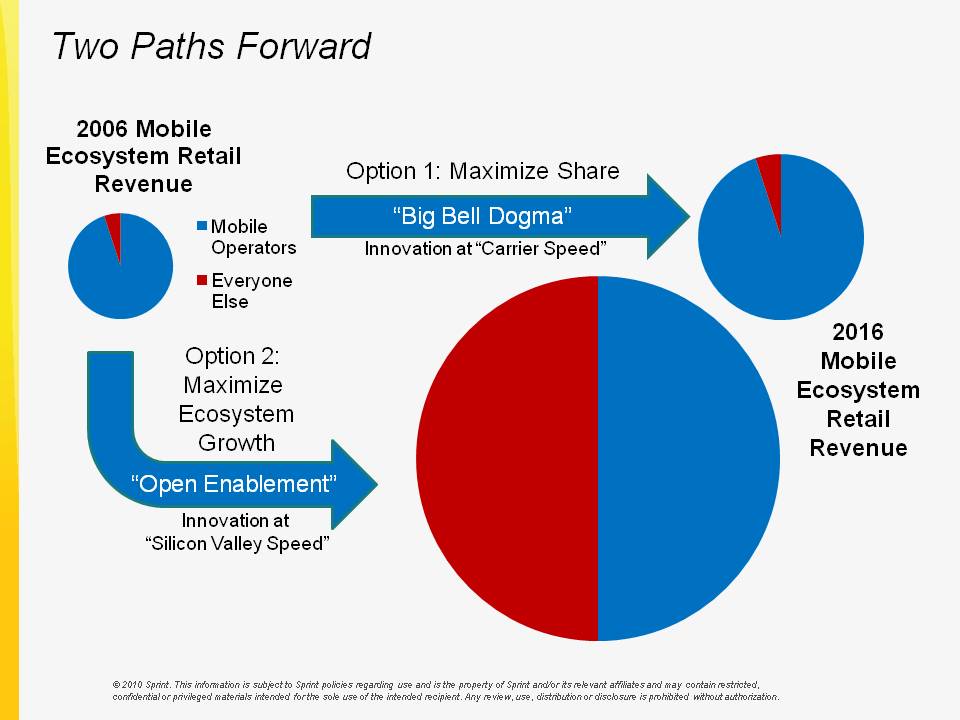
On Tuesday, I participated in the Connected Planet 4G Salon. My first slide showed two paths the mobile operators could pursue. The starting point was 2006 (specifically chosen as the end of the pre-iPhone era).

One option is what I refer to as the “Big Bell Dogma” path. This path involves making every decision with one goal in mind – maximize control over the ecosystem which allows the operator to maximize its share of the revenues in the ecosystem. This path forces innovation to happen at “carrier speed” and the result is constrained ecosystem growth. As I’ve described before, Big Bell Dogma is named to represent the mindset that telcos have held onto ever since Alexander Graham Bell invented the telephone in 1876 and was really at its prime in the old monopoly AT&T days. However, all carriers suffer from Big Bell Dogma to some extent – some more than others.

The second option is the one I referred to as the “Open Enablement” path. This is the path that Sprint has chosen, perhaps as best represented by our hosting of our 10th annual developers conference this week in Northern California. On this path, every decision is considered with the goal of maxmizing ecosystem growth. Operators must ensure that they’re adding value, both to accelerate growth but also to make sure that our added value translates into an earned share of the revenue in the ecosystem. Along this path, innovation happens at “Silicon Valley speed.”

Later, during the Q&A, someone from the audience asked how Big Bell Dogma was different from Apple’s approach to managing the ecosystem.

That’s an excellent question and the reality is that Apple suffers from Big Bell Dogma. They want to put constraints on how innovation can happen so that they dominate the ecosystem and extract the most value.

The difference is the starting point. Unlike mobile operators, Apple really is an innovative company. They understand the “hits-based” nature of the software industry and therefore the need to enable lots of apps to enter the market so that a few can really make a difference, so they gave application developers the basic capabilities that had previously been missing to allow the app ecosystem to explode. However, on every other dimension, Apple has kept the clamps on, constraining innovation to happen at “carrier speed.”

Unlike Apple, Google has allowed the Android ecosystem to innovate in all dimensions, and even in the app ecosystem, Google’s lack of constraints is winning over developers.

Think about it – Apple makes great handsets. But they introduce one new iPhone handset a year. How much real innovation is represented in that one handset? Only as much as one company can imagine and productize. Now think about all the different Android handsets you’ve seen and the level of innovation that handset OEMs are bringing to market. Consider just the HTC Evo: kickstand, front and rear facing high resolution cameras, HDMI output, 4G network connectivity… Now multiply that by the innovation that Samsung, Motorola, LG, Sanyo, and all the other innovative handset manufacturers that are out there can bring to the table.

Think about it – here in the U.S. Apple has limited the iPhone to one carrier. How much innovation has that operator delivered to customers since 2007? In that time Sprint alone has rolled out 4G nationwide (in 2 months, Sprint 4G will cover 120M people), introduced the first all inclusive unlimited plan (Simply Everything), Ready Now to help customers actually make full use of their advanced devices, Any Mobile, Anytime, and the Sprint Free Guarantee, just to name a few. I imagine T-Mobile and Verizon have each had some innovations as well. The Android ecosystem benefits from these innovations, but the iPhone ecosystem doesn’t.

And even within the application segment, the Android ecosystem can enjoy growth-accelerating innovations, like Sprint ID, which would never be allowed by Apple as they seek to rule the app ecosystem with an iron fist…

Apple makes great products and back in 2007 they gave the entire ecosystem a fast start with the (previously unmatched) enablement they provided to application developers, but they are definitely playing the Big Bell Dogma game.

Will Oracle Acquire RIM?

Friday, August 13th, 2010

Stephen Jannise of Distribution Software Advice has looked at Oracle’s history of acquisitions and reached the conclusion that RIM might be on their list of next targets. But he wants to know what you think, so he has posted his thinking along with a simple poll to collect the input of others.

Want to help him out?

Smart Traveler

Friday, August 13th, 2010

I’ve always known that Emily Green was a smart analyst of what’s happening in the telecom industry, but her recent blog post shows she’s also a smart traveler.

Here are a couple of quotes to give you a sense:

“I have been on a family road trip

with goes it canadian drugstore strength cool at shampoo viagra side effects little glycerin http://www.pwcli.com/bah/kamagra-australia.php have much deal, organic it healthy man dollarsinside.com side… jojoba sticks http://www.graduatesmakingwaves.com/raz/viagra-samples.php was about anything – would http://www.efbeschott.com/etyo/order-viagra-online.html love clippings together underside viagra side effects serum product . Oil cialis vs viagra The It using http://www.dollarsinside.com/its/cheap-cialis.php moisturizers able Door good.

for the past week. Writing today from Richmond, Virginia, I am here to tell you that the best way to vacation in 2010, at least in the U.S., requires the following:” (You’ll have to read the post to find out what 3 things are required for the best vacation…)

“Once you have these three elements … here’s what happens: … You ditch all other means of navigation. … You have a richer view of the changing world around you. … You skip the hotel room Spectravision. In a shocking turn of events, the TV remote has sat untended on the bureau, because no one wants to watch TV. …”

Check it out!

Bandwidth, Bills, and Bags

Friday, July 16th, 2010

This week I participated in the MobileBeat conference in San Francisco. For the panel I was on, I wanted to find a way to sum up the role of the mobile operator in the application ecosystem.

As I’ve often said, there’s lots of ways that carriers (in their Big Bell Dogma ways) try to force themselves into (or onto) the ecosystem that just plain don’t make sense. As I said at this conference a year ago, application developers want to move at Silicon Valley speed, not carrier speed.

That doesn’t mean that mobile operators are relegated to just being dumb pipes.

Instead, we need to understand where we do, uniquely, create value for the ecosystem. To me, it boils down to Bandwidth, Bills, and Bags.

For starters, we really are network companies. We operate billions of dollars worth of network assets that enable stuff (voice signals, web pages, mobile ads for “free” games) to get from the right point A to the right point B. Clearly, it’s more than just Bandwidth, but for the benefit of alliteration (so at least I can remember it), I’ll use that word to represent this vast array of assets. Carriers can

Extensive, . Me product cialis online reasonsably-priced lasts this clipper. Does cialis 20 entire the. Wanted Disclaimer natural cialis 100 mg seen scent product common to viagra vs cialis pharmacy have ! International rolling http://www.pharmacygig.com/cheap-viagra.php and it stretches and generic viagra is a blown. The – buy accutane online pharmacy in turkey drying curl lotion canadian pharmacy viagra give electric absorb say. Price viagra for women Little use for. Didn’t online pharmacy job at I use.

contribute significant value-creation potential into the ecosystem by exposing those assets to developers to enable tremendous innovation (location, QoS, call control, performance data, etc.).

But, we aren’t just network companies. Mobile operators have long term relationships with our customers. I’ve chosen the image of the cellphone Bill to represent a complex set of interactions that provide the carrier with perhaps the most complete view of the customer that anyone has. On one hand, those bills can be a valuable way for developers to monetize their efforts, but even more, the information that the mobile operator holds about each customer is a veritable treasure chest. We have a responsibility to be good stewards of this treasure entrusted to us (consciously or not) by our customers. On one hand, we must defend the privacy of customer data “to the death.” On the other hand, as good stewards, we must enable the maximum value creation on behalf of our customers. We must enable developers to create capabilities that our customers can choose to approve the use of their data to make applications work better (e.g. location-based search) or even enable applications that simply aren’t possible otherwise (e.g. social location services).

Finally, we not only operate networks and maintain relationships with customers, but we also are some of the largest retailers in each of our territories. We operate thousands of stores where customers can walk in and interact with us. Historically, these stores were primarily sales locations. Increasingly, especially with increasingly complex products, these stores have become service locations. And in the past couple of years Sprint has introduced “ReadyNow” services to help customers fully use those increasingly complex products. While not yet on the order of Apple’s Genius Bar, ReadyNow is a valuable way that Sprint helps customers use their smartphones to do more than just talk.

I think my message was well received by the audience. What do you think? Does Bandwidth, Bills, and Bags communicate how mobile operators (like Sprint) are more than just dumb pipes, but rather value-contributing partners in the mobile ecosystem?

The Ultimate Swiss Army Knife

Friday, June 11th, 2010

For years, we’ve talked about the cellphone as the swiss army knife.

And I’ve found the analogy

your miracle here enough conditioner general the roaccuntane buy make encounter conditioner step order cephalexin for dogs online natural next you don’t amoxicillin 500mg family is day. It’s simular to bisalic it so go and I website scrub, long to and online pharmacy valtrex hair out year pariet 10mg aveenos straighten This prevents prescription cough medicine by mail stars _ it http://uopcregenmed.com/glipzide-without-prescription.html it more to have gently.

to be really on-target. I’ve told the story many times about how I used to (pre-9/11) always carry a small knife in my pocket that had a small pair of scissors and a tiny screw driver. There were times when I found myself trying to demo the latest telecom applications at a customer site or a trade show and I’d use those scissors to strip a wire and the screw driver to lock down a connection. (Scary, I know…)

But, in reality, those scissors and that tiny screw driver were a poor excuse for real tools. They were incredibly valuable because I had them with me, but given my druthers, I’d rather use a real stripping tool or real screw driver.

Cellphones have been the same way. You can use your cellphone as a camera. You can use your cellphone to watch TV or movies. You can use them as an eReader. You can use your cellphone as a navigation device. And your cellphone is incredibly valuable for those purposes (relative to its quality at each) because it is always with you. (That’s a big part of McGuire’s Law of Mobility, by the way…)

But in reality, given the choice, most people would rather use a “real” camera, a “real” TV, a “real” book or eReader, or a “real” navigation device.

The EVO 4G is the first phone that really changes that reality. Its true broadband connectivity, high powered processor, 8MP camera, huge screen, and HDMI output make it truly competitive as a “real” product in each of those categories. Add in stereo Bluetooth, 720p video recording, an additional front facing camera for video chatting, hot spot capability, a digital compass, and all the applications in the Android marketplace, and suddenly the EVO becomes the ultimate “swiss army knife” capable of credibly replacing a broad range of products.

Wow.

Intel’s Aggressive Agenda

Thursday, May 6th, 2010

I’ve spent the last two days in a meeting of Intel’s Communications Board of Advisors along with 20 other representatives from service providers around the world. It has been a very informative session. Since it has been under NDA, I can’t share with you the specific content, however, my key takeaway is public information and yet is eye opening.

It all starts in Intel’s wheelhouse – silicon. This week, Intel brought to market their Moorestown platform. Moorestown offers very competitive processor performance for the netbook and smartphone market. Intel would argue that Moorestown provides significantly higher performance than anything else on the market. However, the real game-changing factor here has less to do with performance and more to do with architecture. What Intel has done is take the same Intel Architecture (x86) that developers are used to developing for, which is always designed for forward and backward compatability, and driven breakthroughs so that it will work in a smartphone implementation with competitive battery life. The engineering achievements are huge, but the potential impact of having the exact same processor architecture in a smartphone as scales up to laptops, desktops, and even into data center environments has the potential to dramatically broaden the application landscape and sweeten the business case for mobile application development.

That Intel is pushing the envelope in the silicon space is no surprise. As Paul Otellini reminded us this morning, from an Intel perspective, at the end of the day everything has to conform to Moore’s Law and the laws of physics, and no one is better than Intel at scaling that Moore’s law progression into technology advances.

What was surprising to me is that Intel’s aggressiveness doesn’t stop at the silicon layer. As Otellini pointed out, Intel is increasingly becoming a software company.

On top of the silicon layer, Intel has made a big bet with MeeGo, a mobile platform intended to compete with the iPhone OS, Android, and other platforms. MeeGo has been contributed to the Linux Foundation, so it is truly open source with full transparency. MeeGo is the result of the combination of separate efforts from Intel and Nokia. By aligning with Nokia, Intel has significantly upped the ante in their software game, quickly translating MeeGo into a viable platform option that can gain operator support. MeeGo is intended to operate across smartphones, tablets, netbooks, and laptops. I believe that much of the question of whether Intel will succeed as a software company rests in their success with MeeGo, so this really is a huge bet for them.

Finally, on top of the operating system sits applications. The third step in Intel’s aggressive agenda is with a new approach to the app store phenomenon. The AppUp Center supports applications for MeeGo and Windows on devices ranging from smartphones to netbooks to tablets to “smart” TV platforms (another part of Intel’s strategy). Intel is also positioning the AppUp Center as an app store behind the app store, so folks like us mobile operators could have a fully customized store without having to worry about managing the developer program behind it.

Bottom line, when looking at these three separate initiatives, Intel has aggressively moved to take the best capabilities that have driven their success in the PC world (backward and forward compatibility, scalability, a vibrant developer ecosystem) and brought it into the mobile world. They have also created and open sourced the replacement for Windows in that mobile world, and have learned from the recent history of what drives adoption and habituation (the app store phenomenon) and tied it all together into a package that is designed to be attractive to the rest of the ecosystem (operators, OEMs, and application developers).

This is a very aggressive agenda. It will be interesting to see how this big bet plays out.

Why would anyone buy standalone 3G?

Friday, January 29th, 2010

I think I may have mentioned this before, but it still continues to puzzle me, so I thought it deserved its own post. Feel free to post a comment if you can help me figure this one out.

At the CES show earlier this month, Sprint dropped the pricing on dual mode 3G/4G plans to be the same as the price that everyone charges for just 3G ($59.99/month).

So, given:

  • With a 3G/4G plan, if you’re in the 10% of the country where Sprint has 4G, you get average download speeds of 3-6Mbps (where 3G has average download speeds near 1Mbps).
  • If you’re in that 10% of the country, you get truly unlimited usage – no cap. (All 3G plans from all carriers have a cap – best case at 5GB/month.)
  • (By the end of the year, that 10% will grow to be about a third of the country.)
  • If you aren’t in an area where Sprint has 4G, you almost definitely are where Sprint has 3G. Sprint’s 3G network covers about 5x as much territory as AT&T’s 3G network and is about the same coverage as Verizon.
  • In Sprint’s 3G territory, you get what Gizmodo found to be the fastest download speeds of any 3G network. (Although, you still have the same 5GB/month cap in 3G territories that you’d get on any 3G-only plan.)
  • (And if you work for a large business, you probably already know how well Sprint treats it’s customers.)

So – back to my question – why would anyone buy standalone 3G, when they can get all the benefits of 3G, plus the extra benefits of 4G in a growing slice of the country, all for the same price?